International Center of Photography exhibition: "Intimate/ Distant" an interactive multimedia project showcased

In June 2020, I finished my ICP year long New Media Narratives Certification program. Congrats to my fellow classmates! Check out "How the Light Gets In" featuring our work on ICP's website.

Go to ICP's website to check out the exhibition my work: https://oyc2020.icp.org/Betty-Yu

A direct link to “Intimate/Distant” an interactive website, CLICK HERE

Sharing some images from the website here:

"Intimate / Distant" is an interactive web-based documentary project that tells my family’s immigrant stories spanning multiple generations through video, photographs, mixed media collages and archival materials. 

The interactive experience features short video vignettes and images that provide a portal into my family’s journey beginning with the current COVID-19 global pandemic going back to the early days of Chinese Exclusion in 1882. These portals interweave my narration, poetic imagery, photography, archives, collages, verite style scenes and traditional interviews. During the Fall of 2019, I started to photograph my parents and the impact that gentrification has had on their daily life and future in New York City’s Sunset Park neighborhood in Brooklyn. Then COVID-19 changed everything. Instead of photographing my parents in our family house, I have had to rely on FaceTime calls and my mom’s cell phone images to stay connected to them. 

During this time of quarantine, turning inward also meant facing my own discomfort with turning the lens on myself. Specifically the pain and rage I’ve been feeling about the ongoing corona-related anti-Asian violence. This project especially during this pandemic, has allowed me to explore my internal and external life as a Chinese American who holds multiple generations of trauma and resilience in the U.S. These immersive stories provide a glimpse into understanding the experiences of Chinese-Americans that are intimately tied to the U.S. immigration narrative.

Stay safe and #BlackLivesMatter #Justice4GeorgeFloyd

Betty Yu's "Working Stories" Part of Year-Long Public Art Project at the High Line

IN/WITH CHELSEA

Through a series of artworks, In/With Chelsea inserts local memory and advocacy within the streetscapes of North Chelsea surrounding the Spur, the newest section of the High Line.

The street signs will be on view from October 2, 2019 – September 1, 2020.

About the Project:

Artists Lizania Cruz, Shannon Finnegan, Alicia Grullon, and Betty Yu were commissioned to work with local service providers and businesses to engage in storytelling workshops, interviews, and conversations with local residents and workers. As you walk through Northern Chelsea, you’ll find moments of these interactions and neighborhood histories on street signs; signage produced and installed by the New York City Department of Transportation’s Art Program and Sign Shop.

After six months of engagement with partners including Hudson Guild, The Center, Center for Independence of the Disabled, New York, National Domestic Worker Alliance, Esposito Meat Market, GMHC, Fountain House Gallery, and the International Ladies’ Garment Workers’ Union, each artist created a series of street signs to make the historical and social landscape of long-time residents visible to the broader public.

These works add historical context and contemporary voices to inform the narrative of our changing urban landscape. Each artist worked with a different population: senior residents, LGBTQ+ populations, neighbors with disabilities, garment workers, and union laborers.

About Betty Yu’s Working Stories Public Street Sign Project, Part of In/With Chelsea:

Betty Yu looked to capture the labor stories of everyday people—past and present; union and non-union; informal and formal; immigrant, undocumented, and US born. She interviewed a broad cross section of workers—people in retail, labor organizing, the service industry, non-profits, and domestic work. Yu also hosted a story circle with longtime union organizers and members of the International Ladies Garment Workers Union. For Yu, working people are the backbone of this neighborhood, and of the city. “The stories go beyond the parameters of today’s Chelsea,” says Yu. “These are stories from workers who recount the neighborhood before the millionaires, luxury towers, big box stores, and expensive art took over.” In Chelsea, the mix of lower and higher income residents, and of workers and employers, is in constant motion and interaction with one another. The stories Yu collected, and the signs she created, speak of this history, agitation, and change.

For more her project: https://www.thehighline.org/in-with-chelsea-betty-yu/

Click HERE to view the brochure

"In/visible Labor in Chinatown" and "The Garment Worker" exhibited in Punctures Show at Squeaky Wheel Art Film and Media Art Center

Betty Yu's dedicated and expansive work in Punctures is anchored by a sewing machine and interactive scree titled The Garment Worker. This work focuses on the daily life of a garment worker and hardships she/he encounters working in a sweatshop. Visitors can touch the screen to reveal different stories and facts about the garment industry. Anchored by stories from the artist's family, Yu's work expands to both honor the histories of migrant labor in the nation and is an incisive investigation of the ways racial capitalism is integral to the continuing operation of the United States. “The Garment Worker” is contextualized by workers from another project by Betty Yu, “In/visible Labor in Chinatown”, which includes documents, textiles, and a rotary phone, with which visitors are encouraged to interact. Both works speak directly to how three generations of Yu's family live under the effects of the 1882 Chinese Exclusion Act.

This exhibition was part of Punctures: Textiles in Digital and Material Time. Consisting of three exhibitions and public programs that weave into each other, Punctures features artists who are invested in the intersections and history of textile practices, media art, and critical and liberatory politics, including trans fashion and domesticity; gendered and immigrant labor under global racial capitalism; Gelede women’s commemoration, protest and power as represented in textile work; speculative future-casting through Oglala Lakota knowledge systems, and more. The exhibition features installations by Betty Yu, Cecilia Vicuña, Charlie Best, Eniola Dawodu, Kite, and Sabrina Gschwandtner, performances by Charlie Best, Jodi Lynn Maracle, and Kite, and screenings of work by Jodie Mack, Pat Ferrero, Sabrina Gschwandtner, and Wang Bing.

On view from January 10–February 7, 2020 @ Squeaky Wheel Film & Media Art Center, 617 Main Street Buffalo NY. Free and open to the public.

Read about “Invisible Labor in Chinatown”

On view at Squeaky Wheel Film & Media Art Center

Betty's "In/visible Labor in Chinatown" exhibited at Bronx Community College's Hall of Fame

As part of Diversity in Public Art: Empowering Community Voices at Bronx Community Voices at Bronx Community College Betty Yu exhibited her new multimedia installation “"In/visible Labor in Chinatown" .It was an art and community event celebrating the Historic First Hall of Fame in the United States. The works were selected by jury and will be on display and open to the public from September 21st through October 25th, 2019. The painting, sculpture, films, digital art, and various mixed media works featured seek to reexamine the Hall of Fame for Great Americans and ultimately address the importance of cultural diversity in public monuments.

Read more about “In/visible Labor in Chinatown”

“In/visible Labor in Chinatown” at Bronx Hall of Fame Gallery

“In/visible Labor in Chinatown” at Bronx Hall of Fame Gallery

Feb 6 - April 7, 2019: Betty Yu's "(Dis)Placed in Sunset Park" - Part of BRIC Biennial

The opening of a group exhibition where my (Dis)Placed in Sunset Park work is Wednesday, Feb 6th from 7-9pm -part of the BRIC Biennial in Brooklyn, NYC (at the BRIC House on 647 Fulton Street, enter on Rockwell Place) in the Project Room on the ground level.

The show will be up until April 7th.

Betty will also be presenting on an artist talk/ panel discussion "Art and Community Activism" as a part of the exhibition on Fri, March 8th at 7pm at BRIC.

Yu_Betty_Displaced in Sunset Park_02.JPG

CLICK HERE for info about the" “Virtual and Real Estate” show at BRIC’s Biennial (February 6-April 7)

CLICK HERE for more info about the March 8th “Art and Community Activism” Panel

More about her work on view, (Dis)Placed in Sunset Park:

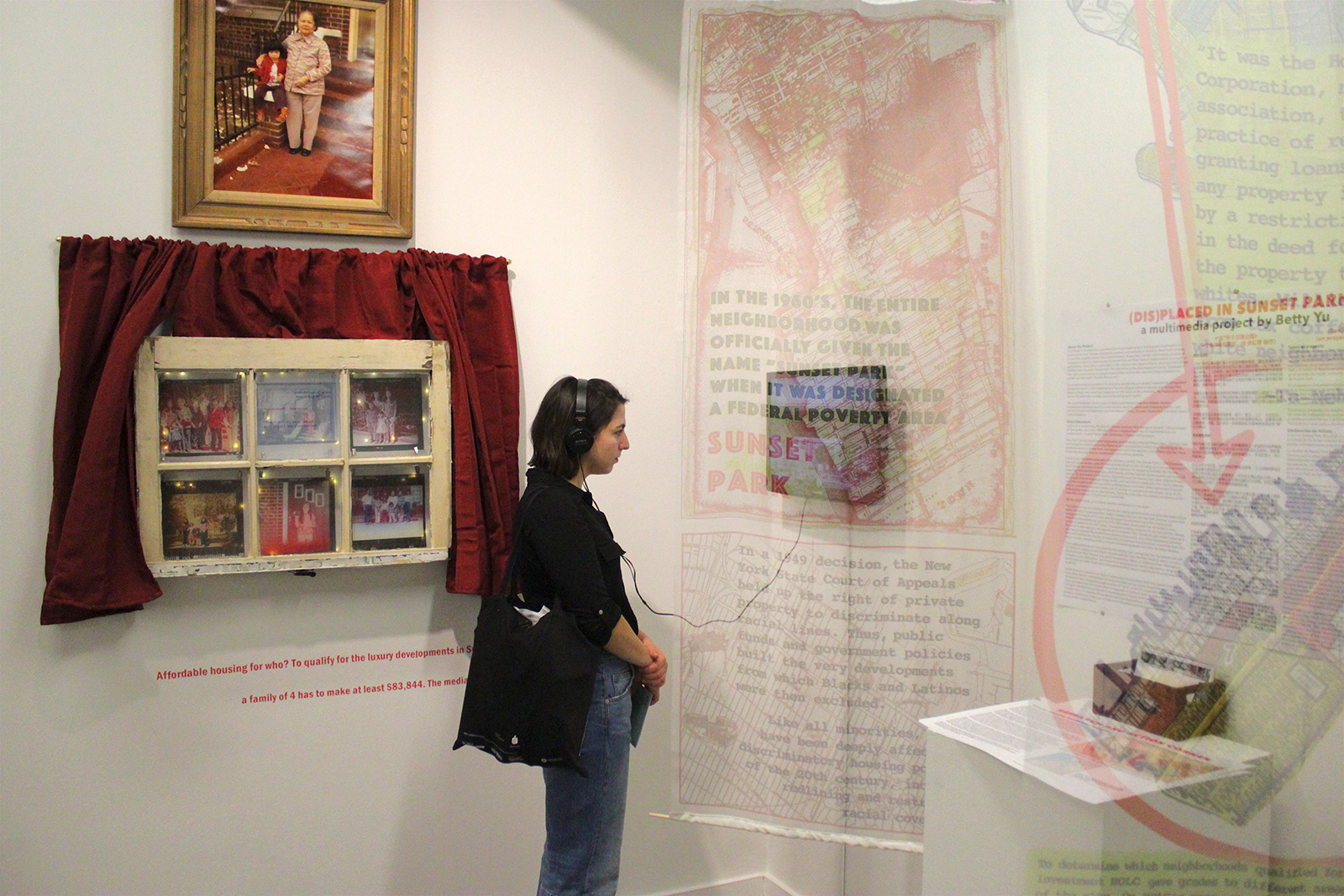
(Dis)Placed in Sunset Park is an interactive multimedia exhibition that features short videos of Latinx and Chinese (im)migrants, workers and residents in Brooklyn, New York’s diverse Sunset Park neighborhood. The common theme among their stories is the shared narrative of migration to the U.S., their journey to Sunset Park and their fears of displacement as a result of gentrification. Each story is grounded in the subject’s own sense of home, sanctuary and refuge that they have found in Sunset Park. The title refers to the way people are being “displaced in” their own community as it changes around them; and to the some are being crowded into smaller quarters within Sunset Park as well.

My family was part of the early wave of Chinese-American families to move into Sunset Park back in the late 1970’s. Using myself as an entry point into the exhibition and project, I document the impact of gentrification on the cultural fabric, community life and changing racial demographics of Sunset Park through my own story and the stories of others. (Dis)Placed in Sunset Park also examines and interrogates the shifting borders of Sunset Park as it relates to the changing boundaries for plans created by real estate speculators and developers. The mapping aspect of this project highlights contrasting definitions of legitimate space and belonging.

More info about the Virtual and Real Estate group exhibition at the BRIC Biennial (on view from Feb 6 - April 7):

In conjunction with the BRIC Biennial: Volume III, South Brooklyn Edition, the Virtual and Real Estate group exhibition features work by artists Pastiche Lumumba, Daniel Bejar, and Betty Yu, that expresses the conundrums that arise from living in an age where the simulated is increasingly confused with the real. Although "estate" has previously been defined as fixed physical properties, the exhibition troubles our notions of property, ownership, circulation, space, and most fundamentally, what it means to be "real." The Internet provides marginalized communities a virtual space for subversion and play, meanwhile distracting from the physical realities of gentrification and land rezoning. From Lumumba's embalmed memes to Bejar's performative drawing of invisible geography, to Yu's archive of stories by communities affected by gentrification, these works challenges the absurdity of place and placelessness to bear on the chronological depth of lived experience. Virtual Real Estate was curated by Connie Kang and Danielle Wu of An/Other, a group of artists, writers, and curators advocating for Asians and Asian-Americans in the arts. 


Studio International: Betty Yu: ‘Wherever you are, there are folks fighting for their lives’

New York-based artist Betty Yu talks about the gentrification of her neighbourhood in Brooklyn and what galleries can do to help

by EMILY SPICER

Betty Yu_Image_article.jpg

Multimedia artist and activist Betty Yu was born in in 1977 in New York City, the youngest of four sisters. When her parents moved to the US from Hong Kong, her mother, Sau Kwan, found work in New York’s garment factories. “Mum worked in more than two dozen factories over a 30-year period,” Yu tells me. “She moved around quite a bit in union and non-union shops. The unionised shops sometimes practised even worse conditions, so it really made no difference.” Yu explored the terrible environment her mother – and many thousands like her – endured, in a documentary called Resilience, which debuted at the Margaret Mead Film Festival in 2000. The film also touched on Kwan’s leadership in the fight against exploitation and the hunger strike Yu’s sister Virginia participated in to draw attention to the exploitative environment in which Chinatown workers found themselves.

An archival photo display of Betty Yu's multimedia project (Dis)Placed in Sunset Park. Open Source Gallery, New York, 2018. Photo: Betty Yu.

An archival photo display of Betty Yu's multimedia project (Dis)Placed in Sunset Park. Open Source Gallery, New York, 2018. Photo: Betty Yu.

Things got worse for the garment workers of New York after 9/11. “A lot of people lost their jobs in Lower Manhattan because Chinatown was so close to the Twin Towers,” Yu explains. “A lot of the trucks couldn’t get in to pick up and drop off garments, and that provided a window of opportunity for the real-estate developers to move in. It was at that point that a lot of workers ended up getting laid off.” Fortunately, her mother found work in Sunset Park, Brooklyn, where Yu and her sisters had grown up.

Much of Yu’s work centres on her Brooklyn neighbourhood, but she has also made a number of short documentaries about social justice and gender. In 2015, she co-founded the Chinatown Art Brigade(CAB) with artists Tomie Arai and ManSee Kong. CAB, a collective that seeks to precipitate change through art, also collaborates with the local tenants’ union to tackle the negative impact of gentrification on Sunset Park. Of course, New York City is not the only place experiencing the effects of what some are calling modern colonisation. Issues of economic and social displacement are global, and the art world, Yu argues, is complicit in pricing out local communities. So what can be done? I spoke to Yu about gentrification and what artists and galleries can do to help.

Emily Spicer: After the hunger strikes featured in your documentary Resilience, did the conditions in Chinatown factories improve?

Betty Yu: The conditions are still bad. The sweatshops are coming back with similar conditions that my mum worked under, but not in such large numbers, so there’s not a lot of media attention because folks think they’re all overseas now.

READ ENTIRE INTERVIEW, CLICK HERE